Showing posts with label pictures. Show all posts

Tuesday, November 8, 2011

Trillium Brewing blog moving

As vaguely referenced in past posts, we have had increasingly burgeoning aspirations to take Trillium more seriously and see if we can make it in to a bigger part of our lives. Over the past ~2 years, we have been busy preparing ourselves for the moments that are upon us now. Esther and I have never been people to limit ourselves to one major life event, so in addition to her building her own business, having our first child, and moving to a new place (that's suspiciously close to a nice place we'd love to be able to buy our own beers one day), we also signed a lease on a 2300SF space in Fort Point in January.
This is probably not particularly new news for those that have found us over on twitter and/or facebook. We've even given a few sneak peeks at the interior of the space, and shared our excitement about the first few shoots of (unofficial) BSA barley grass leaping from the Concord, MA spring soil. Of course, as the fall weather sinks in, we are reminded this all happened well before we had a good appreciation for just how long the 1st building application, community hearing, zoning variance hearing, first facade/design review, second facade/design review and 2nd building permit application processes were going to take--going on 10 months now!

Other than the need to rally some support (which has been truly humbling) for the community hearing, we've tried to stay pretty quiet here. Of course, we've been pretty busy preparing Trillium behind the scenes. Loads of test batches and recipe formulation work that left my laptop keyboard a bit lupulin stained from time to time.
Kevin, Kaity and I cranked out the bones of the website ...but we have held off launching it (until right...now!), because we've been waiting for our building permit from the city. Well, I'm sorry to say we don't have that piece of paper in our hot little hands as of today, but I'm confident we are pretty close.

That, plus I figure the 7mo+ of silence here has gone on for far too long to be fair to those that have been regular readers over the past few years. The good news is that its while we are retiring the homebrewing blog, it'll take up new life here.

We've been giving away so much beer, that 5-10 gallon batches brewed up in a condo kitchen with an even less powerful electric kitchen range just didn't make sense any more. I'm not really a gear head, but experiencing the slumbrew lab was fairly emasculating.

So, that brings us to this past weekend, where a yet-again humbling experience was had when we took our own Trillium Laboratories brewing set up for a test drive. We landed on the Blichmann top tier based system to crank out ~20 gallon batches at Greentown.

Brilliant, kind and inspiring group of people. Honest, too. As one of the engineers strolling by noted as I was struggling to slide Plate C in to Slot 48, "Oh, its like the Ikea equivalent for homebrewing, right?" Yes, complete with the 8 hour assembly time and day after embarrassingly sore hamstrings.

Anyhow, we needed to prepare a bit before the first brew day. One of the very generous greentown companies helped us design, build and dialed in the thermoelectric powered temperature control system for the conical fermenter. Some turbo yeast and about $20 worth of table sugar and continuous data logging made me very confident we would have the all too critical tight temperature control over our ferments.

In the preceding week, I had mentioned to a few friends that we were finally going to fire it up, and we had another humbling show of support. And so glad they did, because there was loads of trouble shooting to tackle that anyone should expect on the first run of any system, homebrew scale or otherwise.
Once we did fire up the burner to heat the strike water, things went amazingly smooth. So much so, that the group even took a few moments to indulge the brewer to drone on about the beers he brought to toast the group (a wild variant of the trillium saison, black currant aged cuvee de tetreault)
Really enjoyed the convenience and efficiency of some higher end equipment (triclamps instead of barbed fittings, counter flow chiller instead of immersion...but yeah, mostly the propane vs electric burner).
So, Esther, Luc and I raise a glass to Jason, Ross, Mitch, Heather, Sorin, Mike, Chris and everyone at Greentown for their generosity and enthusiastic participation. Really feeling the Innovation District love. Also feeling simultaneously guilty and jealous that you are now dealing with the distraction of 20 gallons of Fort Point fermenting away just steps (arm's reach for Ross!) from your workspace! Promise the first keg is all yours, guys.

Monday, January 31, 2011

Ashley's Peaches

~3lbs of thawed native yellow peaches from Ashley's Peaches (~1/2 mile from my parent's house in Acushnet, MA) were crushed and added to a better bottle. 3 gallons of the golden strong sour base was racked on it, December 2010.

When you can get them, these are by far the best peaches I've eaten in my life. I don't care if its marked 'organic' or 'local'...the grocery store stuff is picked when they are rock hard, so if they ever ripen to sweetness, the flesh is usually mealy, grainy bland crap. I don't even bother at this point.

Ashley's are full on real peaches, as they were intended and should be. Ripened on perfectly pruned trees that have been thinned to enhance sun exposure, ripening and full flavor. They'll leave a few leaves on the stem of the fruit, a perfect visual garnish to the sun blushed drupes. The skin can be easily pulled away from the flesh if you can't handle the fuzzyness. When you cut in to them, the juice just drops out (you're going to want that juice), and the very red sugar rich flesh that's close to the pit falls away easily from the stone.
Time and time again in the late summer, I get to re-live childhood, each time you slurp-bite in to an Ashley's peach as you bow over the sink, with the juice dripping down your hands and forearms. This isn't my first rodeo, so I know to roll my sleeves up past my elbows, if I'm wearing them.
Ashley's only puts out pristine product, and only the pristine. They are ready to eat either immediately, or the next day. A third day is pushing it. Every single peach is hand selected and put out for sale, and the locals know to arrive early, so you don't have your hopes dashed by the 'Sold out for today' chalkboard sign that often makes an appearance as early as 11AM. As I'm now an out of towner, part of me wishes they'd give me not-quite-ripe fruit to take home for my beer...the bugs won't mind the wait. But, as a fellow artisan, I wholly understand there is only one way to make your wares available...only when you know they are ready.

So, taking a cue from Ashley's, this beer will stay with the peaches until I don't see positive pressure on the airlock + 3 months.


Golden American Farmhouse

Quite often on my trips over to Europe, there's the hope to find one-oh please let there be at least one- really good beer to help soften the landing after an upside down day of red eye flights, GPS navigated foreign highways, and game-face-on meetings. Duvel almost always fits that bill. I've turned many a colleague on to this alternative to Stella, so it certainly fits that craft beer gateway designation of accessibility. It also has earned its reputation, many times over, for giving crushing hangovers. But for its fair complexion and the unassuming 330ml squat bottle, you can easily down a couple, or even 3 if there's a wait for a table before dinner has even started, only to be met the next morning with the Devil's pitchfork squarely planted in that throbbing nerve that's holding your right eyeball in place.

So, I've learned, very much the hard way, to take it slow. Let the glass in front of me warm a bit and not just do what you'd otherwise be inclined to do - just get after it and slug it down. I've even gotten the colleagues to tolerate, if not enjoy, the process to create the classic, the near unrivaled head that forms when you pour it down the middle in to a matching laser etched glass.

Of course, the beer that created the style is (well, feels) painfully simple to the complexity seeking (geeking) homebrewer-"just" pils, sugar, styrian and saaz to ~30IBUs, duvel yeast w/ the proper fermentation and lagering schedule, bottle condition to big CO2 volumes. There's really no sense in trying to clone this (or other) beers, as you can grab bottles in so many places around here. Of course the simplicity of the recipes belies the exacting nature to successly hit the mark. I think of this beer as a process and fermentation-first beer; no room to hide behind layers of roasted and crystal malts, mounds of masking hop resins.

I felt like exploring the realm of a belgian golden strong with the tenets of duvel yeast, loads of white sugar (6lbs in a 10 gallon batch), base pils malt, but add some push-pull to the easy going grist with some softness of wheat malt and that full spicy feel that you can get from rye. Long, cool mash to help with fermentability. Up the bitterness a bit to match the more-ness of the not just pils grain bill, and good amount of late additions with Styrians and Saaz to keep the impression of an attempt to keep it in the family. Decidedly American influence from the Amarillo. Dry hop with a touch more of each...is this becoming a belgian golden farmhouse IPA?

Reference/influence: this and this.


Brewed on 12/4/2010, 1 liter starter stepped to 5000ml w/ 1.040 wort. First use of the comically sized 5000ml Erlenmyer (which actually has 6500ml total volume).
Started fermentation at 62F, held low 60s for 36hrs, then free rise to mid-70s. Finished very dry to 1.006, ~9.4%abv. No protein floc aids...but even after 2 weeks in primary, this beer looked almost milky with proteins in suspension. Despite turbidity, kept on schedule and dry hopped for 7 days, then racked 1/2 batch to keg to lager 42F, 20PSI (~3vols), 1/2 to bottles. Not milky any more, but permanent haze after 1.5 months of lagering.

Substantial head formation, retention, lacing. Tight protein pillow persists through the quaff. The commercial counterpart still has me beat, however. Clouded, pale orange. Appearance is darker than SRM due to the cloudyness? Amarillo nose, spicy Duvel phenols. Hoppy! Amarillo muscles out the other, more polite hops. But, you know what...I don't want it to be an IPA stacked on top of a Duvel. A firm coarse bitterness is OK, but need to give way to the grainy-ness and yeast metabolites. Rye fullness to the palate despite high-ish carbonation. Wheat cushion keeps it from being too spritzy even when right out of the bottle.

But...uh-oh...the bite of higher alcohols rear their ugly heads. Burn at the back of the nose/throat is screaming at me "I AM A HANGOVER IN A GLASS" ...not in that subtle whispering way that you ignore when you have a Duvel in your glass.

Bitterness is firm and cleansing, to snap back the fusels on your breath... but you hesitate to go back for another whack. As it warms, it actually becomes more pleasant. The hops become more apparent/masking the fusels. Spice and duvel yeast show up well and the rusticity of the grains sit on your tongue with the bittering hops. But you still need to pay the fusel toll. Likely culprit: not enough O2 (aerated, didn't O2 inject). I'll shove these bottles to the back of the cellar, take another look in a few months. Wonder if it'd ever drop bright.

I know this one is closer than its drinking now. Still a bit of a guess w/ the fusels muddying the impression, I have expectations for major tweaks on the next go:
  • though it feels wrong for a farmhouse beer, whirlfloc
  • O2 inject (duh)
  • amarillo bittering addition change to northern brewer (for rustic woodiness)
  • pull back on late hop additions by 1/2
  • eliminate dry hop

Golden Farmhouse
Belgian Golden Strong Ale

Type: All Grain

Date: 12/4/2010

Batch Size: 11.00 gal

Brewer: JC
Boil Size: 13.25 gal Asst Brewer:
Boil Time: 90 min Equipment: My Equipment
Taste Rating(out of 50): 35.0 Brewhouse Efficiency: 70.00
Taste Notes:

Ingredients

Amount Item Type % or IBU
20 lbs Pilsner (2 Row) Bel (2.0 SRM) Grain 68.97 %
2 lbs Wheat Malt, Bel (2.0 SRM) Grain 6.90 %
1 lbs Rye Malt (4.7 SRM) Grain 3.45 %
0.50 oz Amarillo [9.10 %] (Dry Hop 7 days) Hops -
0.50 oz Saaz [5.00 %] (Dry Hop 7 days) Hops -
0.50 oz Styrian Goldings [5.40 %] (Dry Hop 7 days) Hops -
2.50 oz Amarillo [9.10 %] (60 min) Hops 31.2 IBU
1.50 oz Styrian Goldings [5.40 %] (20 min) Hops 6.7 IBU
1.50 oz Amarillo [9.10 %] (20 min) Hops 11.3 IBU
1.50 oz Saaz [5.00 %] (20 min) Hops 6.2 IBU
6 lbs Sugar, Table (Sucrose) (1.0 SRM) Sugar 20.69 %
1 Pkgs Belgian Golden Ale (White Labs #WLP570) [Starter 5000 ml] Yeast-Ale

Beer Profile

Est Original Gravity: 1.078 SG

Measured Original Gravity: 1.078 SG
Est Final Gravity: 1.017 SG Measured Final Gravity: 1.006 SG
Estimated Alcohol by Vol: 8.03 % Actual Alcohol by Vol: 9.42 %
Bitterness: 55.5 IBU Calories: 352 cal/pint
Est Color: 4.5 SRM Color:
Color

Mash Profile

Mash Name: Single Infusion, Light Body Total Grain Weight: 23.00 lb
Sparge Water: 4.22 gal Grain Temperature: 72.0 F
Sparge Temperature: 168.0 F TunTemperature: 72.0 F
Adjust Temp for Equipment: FALSE Mash PH: 5.4 PH

Single Infusion, Light Body
Step Time Name Description Step Temp
75 min Mash In Add 28.75 qt of water at 159.1 F 148.0 F
10 min Mash Out Add 18.40 qt of water at 203.8 F 168.0 F


Thursday, December 9, 2010

Quad + Cuvee de Tetreault: Cabernet Sauv grapes in to the mix

A bit earlier this fall, 5 Gallons of frozen grapes arrived from Midwest supplies, just as the Fall2010 winemaking season was in full swing. I was looking for an interesting fruit addition to give some depth to some of my bigger/darker sours, and I found a really cool option with inspiring commercial precedents (such as this and to a lesser degree, this.)

I pulled the trigger, not on freshly harvested grapes or even current season frozen must. I went with the surprisingly still available (as of Dec 2010) $50 deal on 2007 Cabernet grapes from Napa (picked and crushed on my birthday!). These high brix, huge flavor and tannin grapes from the worldclass americal viticultural area were intended for dark sours already slowly churning away. I would normally eschew pre-processed and the downright old for a fresh/recently harvested version, but, given the consideration of cost (at $200+ for fresh equivalent), I wasn't overly concerned about an erosion of quality given the high sugar content (~23.3Brix) and I'm sure they were stably frozen from harvest to delivery.

Popping the lid showed me no overt signs of freezer burn, even though there was a little more headspace in the bucket than I expected. There was a rubber gasket seal and some tear away plastic that ensured this bucket wouldn't leak, but we all know the oxygen permeability of HDPE. But still...5 gallons of whole frozen napa cab grapes for ~$75? A no-brainer. Jump on it, if you haven't yet and its still available. I'd love to compare notes down the road.
Despite my endorsement, I did feel a twinge of guilt (that continues to nag at me) at the extravagance of the cross country shipping, and ridiculous amounts of styrofoam that was needed to keep them frozen.
I'll prefer in the future to focus on and mostly stick to the best of what the new england regional AVAs have to offer, as there's plenty of the more local and equally high quality options to explore. No, this is not laughable. While the long, warm and dry seasons in the west coast valleys drives the best out of the deep and dark reds, the moderation of the Atlantic coastal climes seems to make the much hardier rootstock of the whites (and earthy Cabernet Franc) truly sing. I'll go so far to say that some of the best methode champenoise sparkling wines I've ever had, come from a sleeper winery in Westport, Massachusetts (snap up all of the Maximilian, should you come across it).

So, I quickly discovered that 5 gallons of cab grapes is alot. ALOT.

After 5lbs of the crushed and mostly thawed grapes went in to the quad rescue attempt and 3.5lbs in to 4 gallons of the Cuvee (6 gallons remain without fruit addition, for now), I still have about 4 gallons of fruit left. I guiltily freezer-bagged up the remaining grapes, and hogged even more of the already hops-choked freezer.


The quad has been souring with the bugs for a descent amount of time now and any activity had slowed to a near crawl. I overfilled the carboy, and after a week, the re-activated microbes were pushing CO2, grapes skins and yeast up through the airlock (and continued to do so for ~1.5 months).

The cuvee was still quite young when the grapes were added (pellicle hadn't even fallen yet), so, despite my better judgement, I added the fruit much earlier than is likely optimal (would prefer than multiple brett strains, lacto + pedio would be favored over the sacch, and a later addition achieves that; sacch tends to lose viability faster than the others).

Only (lots) of time will tell, so I'm looking forward to my first tastes of these in about a year.

Monday, November 15, 2010

Double barley wine, orval'd

During the spike of irrational exuberance that commonly plagues homebrewers with a few solid batches under their belt, about 3 years ago, I decided I wanted to shoot the moon...brew up a ~20%abv double barley wine bomb that could age for years, decades even.

There were a good number of commercial examples that I've read about, sampled a handful. How hard could it be?

Brewing beers before certainly sported loads of enthusiasm. Perhaps lacked a bit of perspective. It had come quite easily. Even the russian imperial stout recipe flagged with the 'expert' connotation in the homebrew magazine seemed to be an easily attained success. Time to up the ante. Way up.

So, I got greedy. I'll google and google and google until my little fingers could google no more, and I'll simply read up on all the brew forums how I could bang out a beer that would push the very limits of yeasty fortitude.

I'll step over the bodies of those that have tried and failed before me (what exactly is a stalled fermentation, anyway? never happened to me before, they must be skipping obvious steps), and ride the apparent attenuation coattails to success.

Should be easy enough.

Trappist high gravity yeast? Yeah, that's the ticket.

40% simple sugars to boost the fermentability of the wort. how extreme! But...why use one, when four different sugars would undoubtedly add a 'depth of flavor'?

Daily aeration? Hmmm, where's that aquarium pump...got it!

No way I can mash enough grain for a 5 gallon batch in my little mash tun, so I'll partial mash this beast, make up the different with extract. I'll split off the batch to give the Cali ale yeast a good start at a reasonable OG, and then really concentrate down the rest of the volume, late addition with the sugars with a FOUR HOUR BOIL. (are you rolling your eyes at me yet?)

Can the concentrated wort and do daily additions...it'll be better (and easier) than dissolving little baggies of reconstituted cane sugar every day for 2 weeks, I'm sure of it.

All that concentrated wort should bring the combined gravity to ~1.170. Yeah, that's what i said. 1.170. Well...no, I didn't measure it. I calculated with my whiz-bang Beersmith software.

Right, I can't be sure, as I didn't think to do a 50% dilution of the final concentrated wort, to be within the range of my hydrometer). Whatever.

A well timed addition of high gravity yeast, made in a high gravity starter w/ some of the canned wort (y'know, you have to acclimate the yeast to what its about to face, right?) will drive that attenuation to my target of 1.025.

OK, maybe I'd be happy with 1.030. It'll need that balancing sweetness to handle that huge alcohol, yes?

6 lbs Amber Liquid Extract (12.5 SRM) Extract 23.35 %
8 lbs Pilsner (2 Row) Bel (2.0 SRM) Grain 31.13 %
1 lbs Cara-Pils/Dextrine (2.0 SRM) Grain 3.89 %
12.0 oz Caramel/Crystal Malt - 80L (80.0 SRM) Grain 2.92 %
3.2 oz Chocolate Malt (450.0 SRM) Grain 0.78 %
1.00 oz Columbus (Tomahawk) [12.20 %] (240 min) Hops 31.0 IBU
1.00 oz Glacier [6.00 %] (240 min) Hops 15.3 IBU
2.00 oz Palisade [6.90 %] (240 min) Hops 35.1 IBU
1.00 oz Cascade [5.50 %] (15 min) Hops 6.3 IBU
1.00 oz Palisade [6.90 %] (15 min) Hops 7.9 IBU
1.00 oz Glacier [6.00 %] (15 min) Hops 6.9 IBU
2.00 oz Oak Chips (Secondary 14.0 days) Misc
4 lbs Cane (Beet) Sugar (0.0 SRM) Sugar 15.56 %
2 lbs 12.0 oz Maple Syrup (35.0 SRM) Sugar 10.70 %
2 lbs Honey (1.0 SRM) Sugar 7.78 %
1 lbs Molasses (80.0 SRM) Sugar 3.89 %

6 months later, that hydrometer wasn't budging.

~1.065
*Hydrometer pictures Oct 2010 (not 1998)

This beer quickly eroded my mounting homebrewing hubris down several notches. But, I couldn't drink it, I couldn't hand over a bottle to a friend (or foe) with a straight face, and couldn't bear to chuck it. Maybe my friend Mike could force carb it, and that would give it the impression of it being dried out with a carb bite to it? Ah, no, tastes like carbonated barley wine cough syrup.

Text that night from mike as he racked it over:

"The gravity is 1.065...want to ferment this a little more first"

Ouch.

So, in this keg, the big beer that couldn't, slumbered for a few years in a basement. He moved to a new house. Hung out down there for a few months, too.

texts, each a loud echo the last, would show up periodically:

"hey, want that barley wine of yours"

Oct. 15, 2010...I took delivery of that embarrassing keg, humbled but hopeful.

The reclamation plan I had already set in motion was eerily similar to the underattenuated quad solution.

Use bugs. Lots of 'em.
Plus a liberal dose of hope.

Start small, though.
Build vigor with time.

Dregs from 2 relatively fresh bottles of Orval.
500 ml 1.040, 1 week, decanted,
1000ml, 1.040 2 weeks, decanted.
2 gallons, 1.038 5 days decanted ~75% (will need some active brett going in, knowing the chances of anything waking up in the super toxic environment, even brett, was slim. Knowing any lacto or pedio in there probably would crash and burn in the cough syrup of a beer, I pinned all my hopes on the fortitude of brett brux var. orval)

Boy, it really hurt racking over from the keg, as the head formation in the 7.9 gallon bucket was downright glorious. Not to mention all the wonderful aromatics hitching a carbonated ride, liberated from the beer.

Yet another learning experience. But, embarassment, shame has given way. I now cherish these 'teachable moments'. I feel thankful for these relatively harmless miscues. There's always next time, the next beer that will be better for it.

I've been slowly, surely accumulating them over the years in my personal bizarro world book of 'how NOT to brew'.

I should have slow bled off pressure over the course of several days, then racked.
Ok, you wild and crazy Belgians...have at this car wreck of a wicked big beer.

Happy to report that after 1.5 months after Orval'ing the wicked big beer, I still have positive pressure on the S-shaped airlock, and a bit of funk emanating from under the plastic. Who knows, maybe I'll realize my dreams of reaching ~1.025 one day, even if it comes a few years later than planned.

Ok, I'd be happy with 1.030.

Sunday, October 24, 2010

Planting the future

Loaded up the car and took the family on a trip back to my hometown of Acushnet to share in the Luc QT and to get some trillium rhizomes in the ground. For about 15 years now, my parents have graciously allowed their frustrated landscaper of a son to cut new garden beds around the entire property and grow up pretty much anything I might want (Pop Tetreault : "whatever you like, as long as its not a willow tree...those roots get in to everything...I don't want anything destroying the septic system"). Most of the early plantings are now mature groups of Peony, iris japonica, allium giganteum or many multiples of the Pee Gee and oak leaf ydrangea.

Despite my fascination with this beautiful North American woodland wildflower, there was still one species that had not worked its way in to the soil until now.

The eponymous Trillium.

Five rhizomes of trillium grandiflorum (Great White), five of trillium erectum (purple/red), and three trillium luteum (a mottled-leaf yellow) were on the docket for the day, so I snuck away for 30 minutes to have a bit of fun in the dirt.

I selected a site in a garden bed that is best suited for these spring time ephemerals, and with some expected dapple shaded neighbors. A mix of native: marsh ferns (Thelypteris palustris) and tall/limbed up golden birch trees (species?) and introduced plants: a flowering japanese cherry and a collection of japanese maples (some named purchased cultivars, some originally seedlings now in their awkward youth from underneath mature specimen trees back in the city.

Unfortunately the soil in this section of the parents property is mostly glacial clay; a soggy root suffocating mess in the late winter/early spring and a parched solidified brick in the inevitable dry spells of the summer. The antithesis of the 'well drained, moisture retaining and high in organic soil' that trillium require.

Thankfully, my parents kept up the heaping compost pile, feeding it regularly with kitchen and yard waste. Pop will turn it a few times a year with the big kubota front loader and supplement it with some manure from my uncle's farm. Really beautiful, well rotted compost. Smells like the forest floor on which it lay. I peel back the outer layer of pulled weeds (unfortuately went to seed) and garden harvest that didn't make Pop's premium measure of quality. The center of the pile is ready to use and the perfect planting soil amendment.
After digging down ~12 inches, I took away 5 wheelbarrow fulls of the dusty, rocky clay coil, which apparently lives in the bizzaro world (it rained pretty well the night before) and replaced it with 4 of the compost and 1 of screened loam, the combination of which will help with drainage/tilth, nutrients and minerals.
The trillium rhizomes were disappointingly tiny. But they were firm and most had lengthy root systems ready to take hold in their new home. They will get settled this fall putting out a bit of root growth before going dormant for the winter. Pop will lay down an insulating layer of finely shredded leaves from the fall yard cleanup, providing further incentive for the earth worms to pay a visit to this site.

Hopefully the little plants will pop up their tri-lobed sepals in the spring and begin the slow but steady growth that will make this in to sturdy stand for the brewery's eventual forest's edge garden planting.

Walking back to the garage to return the shovel, Pop proudly pointed out a lone and youthful rhubarb ...his own recent propagation success story. He had gotten a bit of root from a friend in August and planted it in his raised boxes. The late summer sun fried the leaves to nothing. But underneath, the compost and soil nurtured, kept the roots cool enough to make it through the harsher days to the cool growing season.
After what some people would probably consider too long to be lingering around, talking about the growth of a single plant, we walked back in to the house, knowing that Pepere would have been happy to take part in the fun, and wishing that he was still around to do so.

Tuesday, October 5, 2010

Yeast Hunting near Flanders*

I have been brewing batch after batch of beers with other people's bugs these days, in order to hurry and wait for them to be ready to bottle in 1-2 years. The notion of brewing an american wild ale with truly wild yeast and bacteria that has been nurtured along by my own doing from their primordial beginnings has been growing in romance in my mind for quite some time. I have been reading and re-reading about it. Talking to (at?) anyone who will listen to me go on and on about such things as 'facultative anaerobes'.

Usually starts with a self-indulgently lame lead-in like:
"So, you like sourdough bread, right...? Well, y'know...there are these beers..."

Knowing that some of my favorite beers are created with such wild caught strains, I had to have a hand at it. I know I'm not alone in this, and the chance at finding, creating and learning about beers with as yet undiscovered terroir signature has struck many others before me. Of course, this was (and in the rare case, still is) how beer was brewed for thousands of years, and is experiencing a tremendous revival as of late. Hopefully, I will be able to favor and coax along an otherwise happenstance and motley fungal and bacteria crew (no mold-whammies, no mold-whammies...aaaaaand, STOP!) with some relative simple steps and techniques.

The first step to growing up yeast is the familiar process of making an appropriate medium to capture and grow up the cultures. I started with boiling up a small starter (OG 1.030) with DME and a pinch of wyeast nutrient.
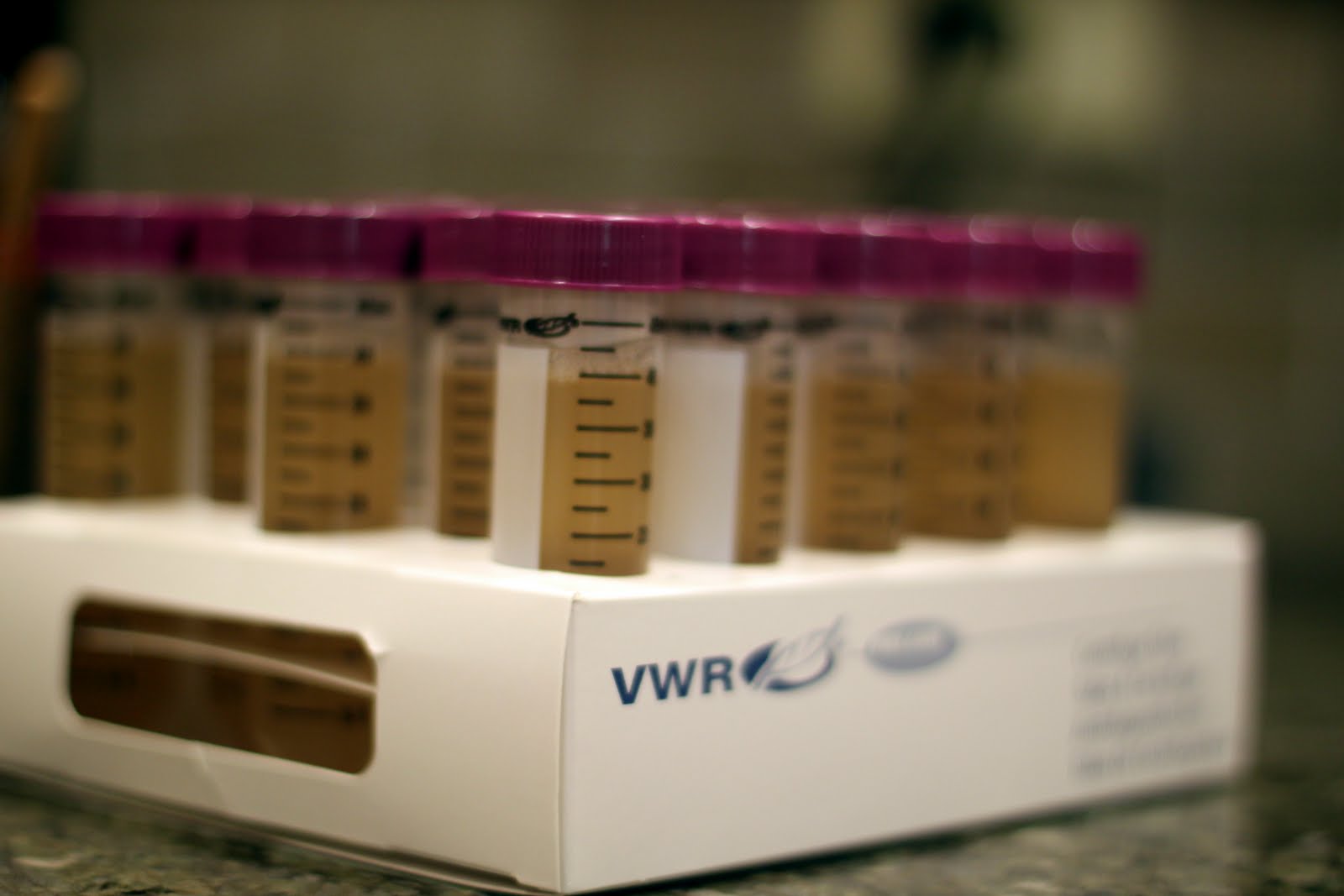
I added 40ml of still hot (~170F+) wort to eleven sterile 50ml centrifuge tubes and re-sealed the threaded caps. Threw them in a gallon ziplock bag the morning before driving down to Saltwater Farm vineyard for their 2010 Chardonnay harvest. Here's a video peek of the place from last year's Halloween Cab Franc harvest.
The mood was considerably more energetic at this year's harvest. Of course the vines are another year older, but the grapes were pushing the brix count north primarily from the long, warm and sunny season, and the tons/acre harvest (I hear) was exceptional. Lots of new french oak barrels (ooooooh boy) lay in waiting for the Chardonnay. I spent a few minutes, alone, in silence, just being near them, smiling widely.
Outside, the surrounding wetlands and fields were thick and lush. Plants that are usually winding down to dormancy this time of year, exhausted from the efforts of flowering and then setting seed, were flagrantly reblooming.
Lots of yeast-feeding nectar was still aplenty, so the yeast conditions were quite good, but not ideal. Both the night and day time temps have been cool, as of late (good), but the rains came through a few days (not so good). I could see that the whitish haze that typically has set up camp on the grapes has been washed off a bit, though still quite visible toward the bottoms of the clusters.

I had big Luc strapped to me, so my harvesting efforts were probably measured in the 10s of pounds, not hundreds, but Esther and Anne-Marie quickly filled the trays in the overcast ~55F weather.
I opened a few vials and pushed 4-6 of those bottom-of-the-cluster grapes in to each. I wandered around the grounds, snagging 4 different varietals: Sauvignon Blanc (3), Chardonnay (3), Cabernet Franc (2) and Merlot (2).
Not so much because I postulated that Id get different strains from the different grapes, but rather there might be micro climates hidden within the micro climates of the vineyard, each yielding some different microbiota. With the 11th vial, big Luc I went for another 20minute stroll through the vines, with the cap off...making our own mini-Lambic. For the record, I too don't really wish to enter in to a debate of the 'proper' use of the appellation...

Our good friends, the vineyard owners, were quite generous to heed my request for 5lbs of the Cabernet Franc, for use in adding to a portion of the strong pale sour beer I brewed not too long ago. When we returned home, Esther took the Luc-handoff, and I went to work destemming these pristine/mold free clusters by hand. In to a washed stainless bowl, then vacuum seal bags, then the freezer. 4lbs, 10oz. I had hoped for 5 on the button. Nuts.

I'll add the grapes after the Sacch/Brett has been knocked back a bit by the lowered pH levels, and give the now stronger pedio something fresh to call dibs on.

It is now already three days later, and I've seen clear signs of fermentation, first on the white grapes, then the red, but nothing too definitive yet in the 'open air' vial. I'll likely chill, then decant the grapes and wort tomorrow evening. A familiar whitish sediment is settling on the bottoms of the most active vials, and bright hints of vinous fermentation gases are sneaking from under the plastic screw tops.

The agar, sterile Petri dishes, inoculation loop, and small scale Erlenmyers are on their way. Meanwhile, I'm only about 1/2 way through Yeast, so I've got some work ahead of me.

And at least I have Luc to let me go on and on (for now, anyway) about my hopes of finding the elegant, yet rustic Tetreault strains, and dreaming about going yeast hunting in own family farmhouse brewery one day.


*Flanders (Road)
Related Posts with Thumbnails